AI has already moved beyond simple chatbots and recommendation engines. AI agents can plan, make decisions, and carry out tasks with minimal input, almost like a digital coworker handling work in the background. And adoption is picking up fast. In fact, 62% of organizations are already experimenting with AI agents.
As businesses look for smarter ways to scale, understanding how these agents work is becoming hard to ignore.
What is an AI Agent?
A system that autonomously completes tasks by creating workflows using accessible tools is known as an artificial intelligence (AI) agent.
Beyond natural language processing, AI agents may do a variety of tasks, such as making decisions, solving problems, interacting with the outside world, and carrying out activities.
AI agents handle challenging tasks in a variety of enterprise applications, such as code generation, software design, IT automation, and conversational support. Large language models (LLMs) employ sophisticated natural language processing techniques to understand and react to user inputs in a step-by-step manner, as well as to decide when to use external tools.
How Do AI Agents Work Under the Hood?
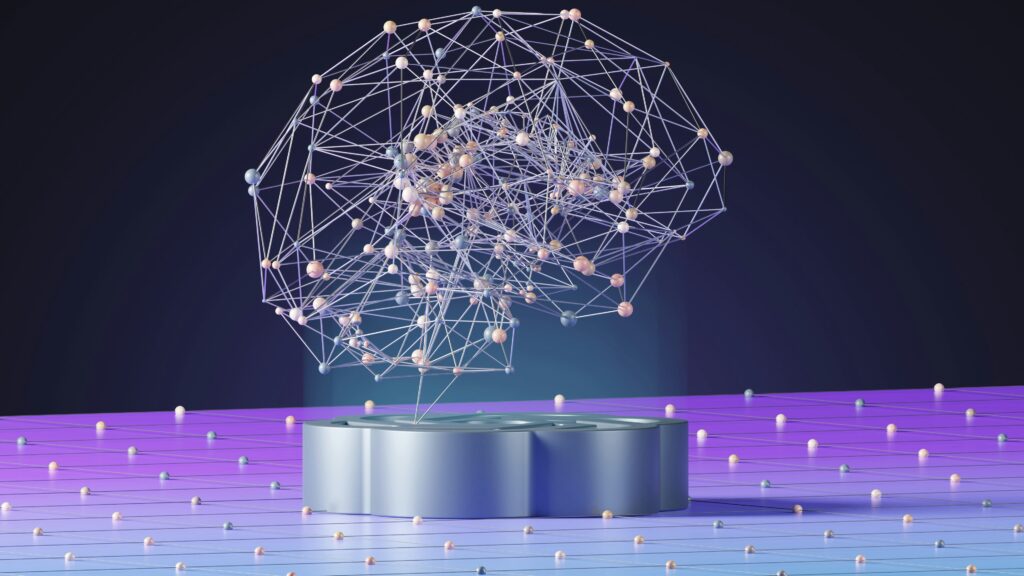
Large language models (LLMs) are the foundation of AI agents. Because of this, AI agents are frequently called LLM agents. Conventional LLMs, like IBM Granite® models, are limited by knowledge and reasoning constraints and generate their answers based on the training data. Agentic technology, on the other hand, makes use of a tool calling on the backend to get current data, streamline processes, and generate subtasks on its own to accomplish challenging objectives.
Over time, the autonomous agent gains the ability to adjust to user expectations. A customized experience and thorough responses are encouraged by the agent’s capacity to keep previous encounters in memory and anticipate future actions.
This tool calling increases the potential uses of these AI systems in the actual world and can be accomplished without human participation. How agents function is defined by these three phases, or agentic components:
Goal Initialization and Planning
While AI agents can make decisions on their own, they still need human-defined objectives and guidelines. The behavior of autonomous agents is influenced by three primary factors:
- The group of programmers who create and instruct the agentic AI system.
- The group responsible for deploying the agent and granting the user access.
- The user who sets available tools and gives the AI agent particular tasks to complete.
The AI agent then performs a job breakdown to enhance performance based on the user’s objectives and the tools at its disposal. In order to achieve the complex aim, the agent basically develops a plan for certain tasks and subtasks.
Planning is not a crucial step for simple activities. Rather than planning its future course of action, an agent might iteratively review and refine its replies.
Using The Tools at Hand to Reason
The information that AI agents see informs their actions. But they frequently lack the comprehensive understanding needed to address each subtask inside a complex aim. They use readily available resources like external datasets, web searches, APIs, and even other agents to close this gap.
The agent uses agentic reasoning and refreshes its knowledge base upon obtaining the missing data. This approach allows for better informed and flexible decision-making by constantly reviewing its course of action and making self-corrections.
Imagine a user organizing their trip to assist in explaining this procedure. The user gives an AI agent the duty of forecasting which week in the upcoming year will probably have the finest weather for their trip to Greece to surf.
The agent cannot rely only on its own knowledge because the LLM model at its foundation is not an expert in weather patterns. As a result, the agent collects data from an external database that has daily weather reports for Greece for a number of years.
The next subtask is formed because, even with this new information, the agent is still unable to identify the ideal weather for surfing. The agent interacts with an outside agent that specializes in searching for this subtask. Let’s say the agent discovers that the ideal surfing conditions are high tides and sunny weather with minimal to no rain.
The agent can now find patterns by combining the knowledge it has gained from its tools. It can forecast the week in Greece that will probably have high tides, sunny skies, and little chance of rain next year. The user is shown these results. AI agents can be more versatile because of this information exchange between technologies.
These capabilities power real-world systems where AI agents can autonomously manage workflows, such as IT ticket handling with ServiceSafeAI, engineering assistance through EngSafeAI, or business analysis using DAISY.
Learning and Reflection
AI agents employ feedback mechanisms like human-in-the-loop (HITL) and other AI agents to increase the accuracy of their responses. To illustrate this procedure, let’s go back to our earlier surfing example. In order to enhance performance and adapt to user preferences for future objectives, the agent retains the learned information together with the user’s feedback after crafting its response.
Feedback from other agents may also be utilized if they were employed to accomplish the goal. When it comes to reducing the amount of time that human users spend giving instructions, multi-agent feedback can be particularly helpful. To better match the outcomes with the intended objective, users can additionally offer input during the agent’s actions and internal reasoning.
AI agents can also store information about solutions to past challenges in a knowledge base to prevent making the same mistakes twice.
AI chatbots: Agentic vs. Nonagentic
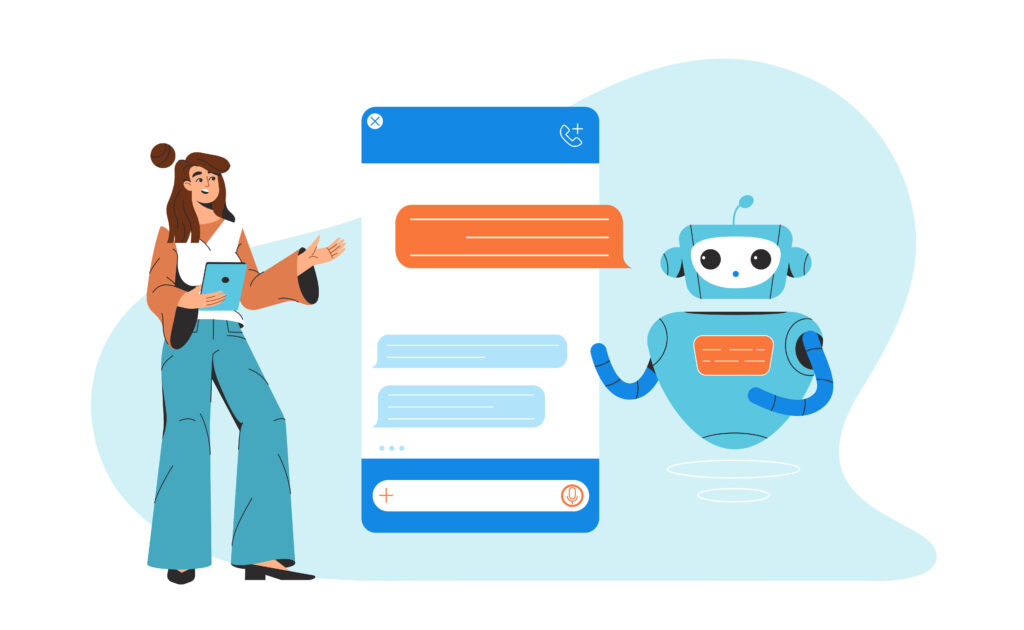
Chatbot technology. Flat woman chatting and communicating with artificial intelligence. Smartphone interface with chat bot dialog message icons at screen. AI robot assistant, online customer support.
Natural language processing (NLP) and other conversational AI techniques are used by AI chatbots to comprehend user inquiries and provide automated answers. While agency is a technological framework, these chatbots are a modality.
AI chatbots that lack tools, memory, or reasoning are known as non-agentic chatbots. They are unable to plan ahead and can only accomplish short-term objectives. Nonagentic chatbots, as we know them, need constant input from the user in order to react.
They perform badly on inquiries specific to the person and their data, but they can generate answers to general prompts that are probably in line with user expectations. These chatbots cannot learn from their mistakes if their responses are inadequate since they lack memory.
Agentic AI chatbots, on the other hand, provide more individualized experiences and thorough answers as they gradually learn to adjust to human expectations. By generating subtasks without human assistance and taking into account various strategies, they are able to finish complicated jobs. Additionally, these plans can be updated and self-corrected as necessary. Unlike nonagentic chatbots, agentic AI chatbots evaluate their tools and make use of the resources at their disposal to fill in knowledge gaps.
Types of AI agents
Once you know what are intelligent agents and how are they used in AI, you need to understand their types. Different degrees of capability can be built for AI bots. For simple objectives, it may be better to use a simple agent to reduce needless processing complexity. There are five primary agent types, ranked from most basic to most sophisticated:
- Simple Reflex Agents
The most basic agent kind that bases behavior on perception is simple reflex agents. You might wonder how do AI agents communicate with each other. In the event that it lacks information, this agent does not communicate with other agents or store any memory. These agents operate according to a set of “rules” or “reflexes.” This behavior indicates that the agent is preprogrammed to carry out actions in response to specific circumstances.
The agent cannot react effectively if it comes upon a scenario for which it is unprepared. The agents work well in fully observable contexts where they have access to all the information they need.
For instance, a thermostat that activates the heating system at a predetermined time each night would turn on the heating at 8 PM.
- Model-Based Reflex Agents
Model-based reflex agents keep an internal model of the world by using both their memory and their current perception. The model is modified as fresh data is received by the agent. The agent’s model, reflexes, prior precepts, and current state all influence its behavior.
Unlike basic reflex agents, these agents have the ability to store information in memory and function in partially visible and changing contexts. They are nevertheless constrained by their own set of regulations.
A robot vacuum cleaner is one example. It detects obstructions like furniture and moves around them while cleaning a dirty room. In order to avoid becoming trapped in a cycle of cleaning, the robot also keeps a model of the regions it has already cleaned.
- Goal-Based Agents
Goal-based agents have an internal model of the world. Before taking any action, these agents plan the sequences of activities that would help them achieve their objective. Compared to basic and model-based reflex agents, this search and planning increases their efficacy.
A navigation system that suggests the quickest path to your destination is one example. The model takes into account different paths that lead to your objective, or destination. In this instance, the agent’s condition-action rule specifies that it will suggest a faster path if one is discovered.
In regulated industries, goal-driven agents are already applied in systems like KIRA for employment law workflows or AirSafeAI for aviation compliance, where decision accuracy and adherence to rules are critical.
- Utility-Based Agents
Utility-based agents choose the course of action that maximizes utility or reward while also achieving the goal. A utility function is used to calculate utility. Based on a set of predetermined criteria, this function gives each scenario a utility value, a metric that indicates how beneficial an action is or how “happy” the agent is.
Progression toward the objective, time constraints, or computational complexity are a few examples of the criteria. The acts that maximize the expected utility are subsequently chosen by the agent. These agents are therefore helpful when choosing the best option among several situations that accomplish a desired goal.
- Learning Agents
Although they have the same capabilities as other agent kinds, learning agents are distinct due to their capacity for learning. Their original knowledge base is expanded by new experiences, which happen on their own. The agent’s capacity to function in novel settings is improved by this learning. Learning agents consist of four primary components and can be goal-based or utility-based in their reasoning:
- Learning: This process enhances the agent’s knowledge by using its sensors and precepts to learn from its surroundings.
- Critic: This part gives the agent feedback regarding whether the caliber of its answers satisfies the performance requirement.
- Performance: This component is in charge of choosing what to do after learning.
- Problem generator: This module generates a number of suggestions for possible courses of action.
An example is recommendations on e-commerce websites that are tailored to each individual. In their memory, these agents monitor user behavior and preferences. The user is given recommendations for specific goods and services based on this information. Every time a new recommendation is given, the cycle is repeated. For educational purposes, the user’s activity is continuously recorded. By doing this, the agent gradually increases its accuracy.
Applications of AI Agents
Artificial intelligence ai robot gives recommendation, human get automated response from chatbot, business consulting system, isometric vector neon dark
So, how do AI agents work together? AI agents have swiftly progressed from abstract ideas to practical uses in a wide range of industries. Their application demonstrates how adaptable and successful they are at resolving challenging issues.
Customer Experience
By acting as virtual assistants, offering mental health support, simulating interviews, and performing other relevant functions, AI agents can be included in websites and applications to improve the user experience. The process of developing these AI agents is made even simpler by the abundance of no-code templates available for user implementation.
Medical care
Numerous practical healthcare applications can make use of AI agents. In these kinds of situations, multi-agent systems can be helpful for solving problems. These technologies free up medical personnel’s time and energy for other pressing activities, such as managing medication processes and arranging treatments for patients in the emergency room.
Response to emergencies
AI agents can employ deep learning algorithms to retrieve user data from social media platforms in the event of a natural disaster. Rescue agencies can save more lives in less time by mapping these users’ locations. As a result, AI agents can significantly improve human lives in both routine, monotonous jobs and life-saving circumstances.
Supply chain and finance
Agents can be built to optimize supply chain management, predict future market trends, and evaluate real-time financial data. Autonomous AI agents can be customized to produce outputs that are tailored to our individual data. Enforcing security measures for data privacy is crucial when working with financial data.
Conclusion
AI agents show an advancement in artificial intelligence technology. They have influenced how experts approach difficult problems and how firms function.
AI assistants and conventional software are not the same as AI agents. They stand out for their independence, flexibility, and goal-oriented functionality. With little human supervision, these systems are able to sense their surroundings, process data, act, and learn from feedback. We learned in this guide on how do AI agents work autonomously that these characteristics make them effective instruments for resolving challenging business issues.
The catch is that these “agents” are only as good as our perception of them. Understanding their design, ethics, and practical applications becomes increasingly important as they develop from reactive responders to proactive problem-solvers.
Start Building AI Agents That Deliver Measurable Impact
Understanding how AI agents work is only the first step. Real value comes from deploying systems that can plan, act, and continuously improve within your business environment. AI Factory Labs helps organizations move beyond experimentation and into production-ready agentic AI.
Their approach focuses on building systems that integrate seamlessly and scale with your operations:
- Custom AI Agents: Designed around your specific workflows, use cases, and business logic
- System Integration: Connects effortlessly with your existing tools, APIs, and data infrastructure
- Multi-Agent Workflows: Coordinates multiple agents to handle complex, interdependent tasks
- Continuous Learning: Improves outputs over time using feedback, memory, and real-world usage
- Scalable Deployment: Built to perform reliably across growing workloads and enterprise environments
Organizations that move early gain a structural advantage through faster execution and smarter systems. AI Factory Labs brings the clarity and technical depth needed to make that transition effective.
Partner with AI Factory Labs to design and deploy intelligent, autonomous systems aligned with your business objectives.